

Synod study group promotes women’s leadership in Church
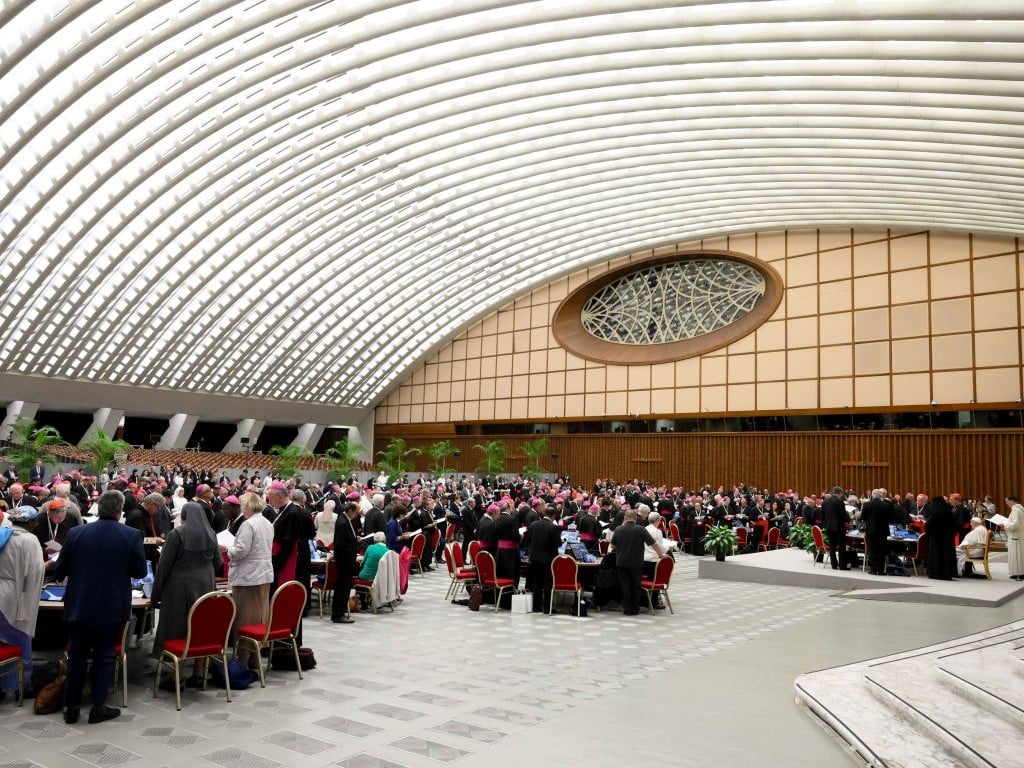
Members of the assembly of the Synod of Bishops start a working session in the Vatican's Paul VI Audience Hall in October, 2023. (CNS photo/Lola Gomez)
A study group created as part of the Synod of Bishops on Synodality examined “women’s participation in the life and leadership of the Church”. Its final report was published on March 10.
The group, established by Pope Francis and whose work was carried out by the Vatican’s Dicastery for the Doctrine of the Faith, said the Church must grapple honestly with cultural and institutional obstacles that continue to affect women’s participation in ecclesial life.
“There exists within the contemporary ecclesial mentality a certain pattern of thought and behaviour identifiable as ‘clericalism’ or ‘machismo’,” the report said, adding that such attitudes create “distrust and, not least, distance among women”.
Clericalism was defined as “the tendency to transfer automatically the authority and unique role that properly belong to the priest in the celebration of the Eucharist into all other areas of community life”.
The report included a reflection seeking to “trace possible directions for development that may help define new spaces for the participation of women in the leadership of the Church”.
It noted that the active participation of women in the life and governance of the Church is not a “concession” granted by hierarchical authority, and it should be possible to “move beyond a logic that is merely related to function or substitution, instead, recognising that women possess a right in this regard insofar as they are baptised and bearers of charisms”.
Citing the appointment of women to leadership positions by recent Popes, the report stated that “alongside the sacramental path and distinct from it, there is also a charismatic path that can be fruitfully pursued to open new spaces of participation for the lay faithful, particularly for women. It follows that even in the exercise of governance within a diocese, opportunities of this kind may arise and should be employed”.
“The discernment of such charisms is the responsibility of the bishop,” the document said, noting that “the lay faithful do not participate in Holy Orders but rather in the exercise of the bishop’s ministry”.
The report said it is important that “theology and canon law explore new forms of exercising authority grounded in the sacrament of Baptism and distinct from those deriving from Holy Orders, so that adequate canonical forms may be found to make effective the participation of women in roles of leadership within the Church”.
The report also called for expanding women’s access to existing instituted ministries, such as the ministry of catechist or lector, and for the creation of new roles that could recognise women’s contributions to Church life.
And it stated that the Church must move beyond any view of women limited to certain characteristics “such as motherhood, tenderness or care” that can “leave little room for other equally important feminine qualities, such as leadership, counsel, the capacity for teaching, listening and discernment”.
FULL STORY
Synod study group defends women’s leadership in the Church (By Justin McLellan/National Catholic Reporter)
What to make of the Synod’s final report on women in the Church (Catholic Herald)
The Participation of Women in the Life and Leadership of the Church (Synod of Bishops)
RELATED STORY
Pope Leo XIV decries violence against women, appeals for respect of equal dignity (Crux)

Ad

Ad
The latest from
CathNews



Newsletter Signup
Receive CathNews New Zealand updates in your email every Tuesday and Friday