

Encyclical stresses human dignity safeguarding: NZ bioethicists
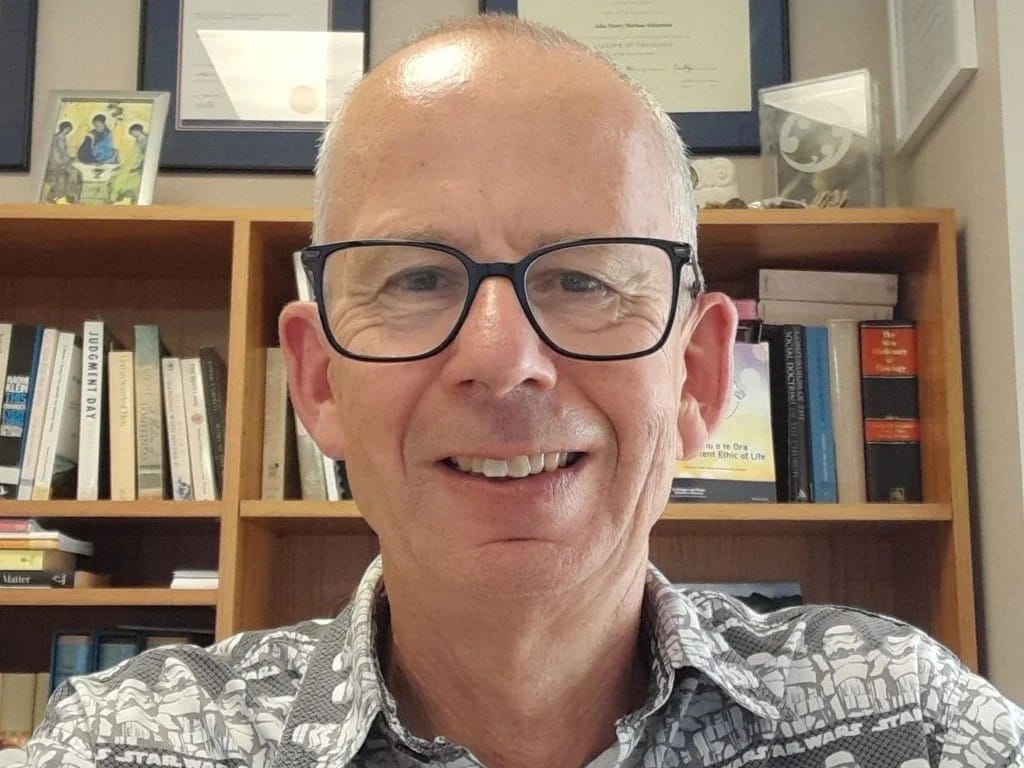
Dr John Kleinsman (Te Kupenga)
In comments in an opinion piece and provided to CathNews New Zealand, Dr Kleinsman, director of the Nathaniel Centre for Bioethics, and senior researcher Dr Marcar noted the strong language used by Pope Leo regarding the need to “disarm AI”.
This is “language driven by an imagined but not-unrealistic future in which, ‘in the name of progress “necessary sacrifices” may begin to be justified, placing the burden on the most vulnerable in pursuit of a supposed optimisation of the human species’ – a world in which ‘if the human being is treated as something to be perfected or surpassed, it becomes easier to accept that some lives are less useful, less desirable or less worthy’”, stated the bioethicists, quoting from the encyclical.
“Pope Leo’s appeal to the notion of disarming is clearly deliberate on his part,” Dr Kleinsman commented. “I imagine that the Pope would have been well aware of the imagery that his language would evoke for many people given its common use in reference to the catastrophic global dangers posed by nuclear armaments. He is issuing a warning of the greatest magnitude – ultimately a warning about the potentially devasting impact on human freedom, truth, communication and democracy.”
“At the same time,” Dr Marcar noted, “Pope Leo acknowledges that AI is here to stay, describing it as ‘an environment in which we are immersed’, ‘a new dimension of our home’ and something already to a significant degree ‘interwoven into the fabric of daily life’. The Pope specifically states that his call to disarm AI does not mean rejecting the technology. Rather, it is a matter of ‘preventing it from dominating humanity’ while employing it as part of the ‘construction site of hope that we call the “civilisation of love”’”.
“As to what he means by the term ‘disarm’, Pope Leo is very clear that the issue facing humankind is not simply one of regulating the technology. As he writes in paragraph 110, ‘merely regulating it is insufficient’. At stake is nothing less than our vision for human flourishing and the world we live in – whether a ‘human-centred, relational vision’ or one ‘guided by an outlook that devalues human limits and promises a purely technical form of salvation’, as the Pope noted in paragraph 117 of the document.”
“This takes us to the core of Pope Leo’s rationale in writing this encyclical,” said Dr Kleinsman. “While the document is being spoken of, somewhat loosely, by many as an encyclical about AI, I regard it as ultimately focused on anthropology – as grappling with what really makes us human and, more specifically, what it means to be authentically human in the current age, an age defined, among other things, by the ‘technocratic paradigm’ that is increasingly characterised by AI.
“At the same time, Pope Leo goes further than acknowledging AI as a force that is here to stay, which by itself could indicate little more than a grudging acceptance of it. He also imagines a world in which AI is welcoming and accessible; a world in which technological intervention can truly be said to ‘represent human participation in the divine act of creation’ as opposed to being defined by a ‘mentality of “armed” competition’ that benefits a few at the expense of the most vulnerable.”
Dr Marcar noted that, in focusing attention upon the needs of those most vulnerable within today’s “digital ecosystem”, Pope Leo urges a particular consideration for the effects of AI on children, adolescents and educational systems. This is epitomised by his call in paragraph 170 of the encyclical for “digital sobriety and the protection of minors, thus countering models that exploit vulnerability”.
“By acknowledging the immense potential of AI for humankind as well as its risks, Pope Leo places himself firmly on the via media and in the longstanding Catholic tradition of finding ‘the middle way’, which is not to be understood as ‘sitting on the fence’ but, rather, as reconciling, and thus avoiding, two extremes,” said Dr Kleinsman.
FULL STORY
New Zealand Catholic Bioethicists Reflect on Magnifica Humanitas (Te Kupenga/The Nathaniel Centre for Bioethics)

Ad

Ad
The latest from
CathNews

Newsletter Signup
Receive CathNews New Zealand updates in your email every Tuesday and Friday