

US report links religious practice with mental wellbeing
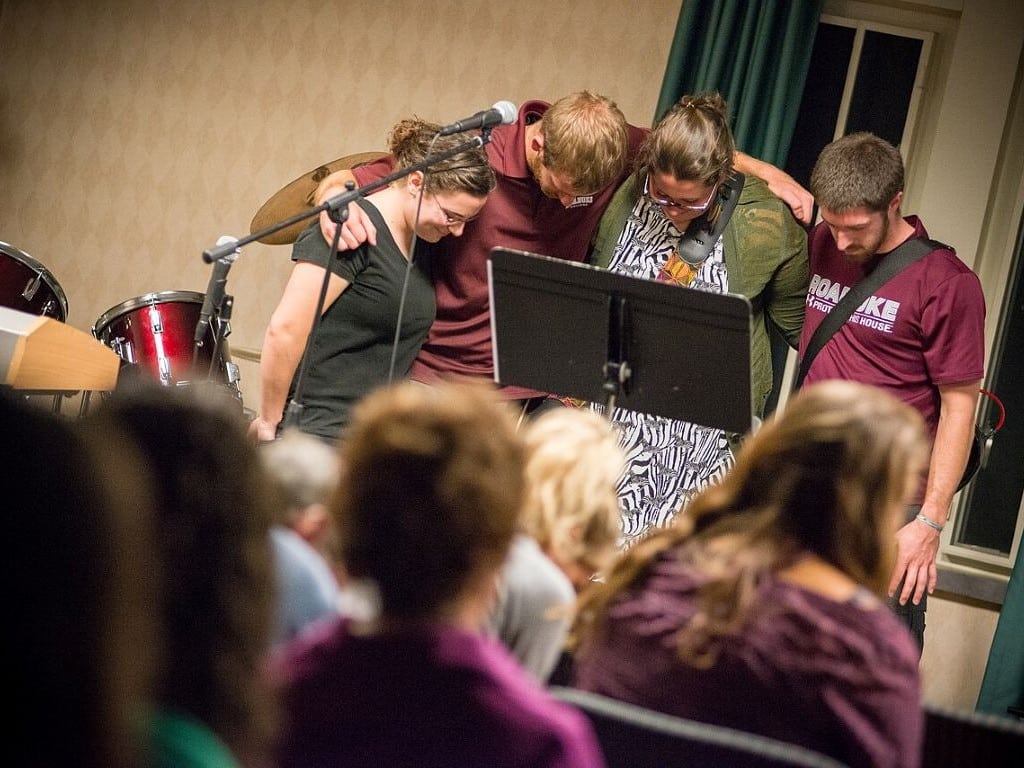
Prayer service on a US college campus (Roanoke College/Wikimedia Commons)
The Wheatley Institute at BYU describes as its basic mission “Research-supported work that fortifies the core institutions of the family, religion and constitutional government.”
Citing an analysis of hundreds of previous studies, the report stated that committed religious involvement – corresponding to at least weekly attendance at worship services – was linked to lower suicide risk, better stress management, reduced substance misuse and higher levels of hope.
“Although harmful or coercive forms of religion do exist, the overall pattern across the best available studies is clear: religious belief and practice are overwhelmingly associated with better mental and emotional wellbeing,” the report said.
Charles Camosy, a professor of moral theology and bioethics at The Catholic University of America, gave the Associated Press a nuanced view on the subject.
“We expect on the one hand that being faithful will bring with it good things in this life,” Professor Camosy said.
Yet “living out the Gospel doesn’t lead to healthy, flourishing lives for everyone. People still get sick, including mentally ill”, he added. “Christians, and especially faithful Christians who are salt and light in a world full of violence and injustice, are not promised mental health as a reward for faithfulness in this life.”
Visiting psychology instructor at St John Fisher University in New York state Timothy Powers said, “While faith community participation can confer real and well documented protective benefits, those same communities can also be sources of shame, spiritual bypass, trauma and significant barriers to seeking help”.
“Clinically, both realities show up in the counselling room, sometimes in the same person.
“The task for therapists is to approach the subject without assuming that religion/spirituality is a resource or that it is a wound, to be open to ambiguity, and to ask rather than presume,” Mr Powers added.
The executive director of the American Humanist Association, Fish Stark, said he had no quibble with the assertion that religious engagement may have psychological benefits. But he stressed that non-religious people had ways to fare equally well.
“If you have a strong secular, atheist identity and actively participate in a non-religious community, you get the same benefits,” Mr Stark said.
FULL STORY
Does frequent worship lead to better mental health? Often, but not always, experts say (By David Crary/Associated Press/CruxNow)

Ad

Ad
The latest from
CathNews



Newsletter Signup
Receive CathNews New Zealand updates in your email every Tuesday and Friday